New Guitar – Epiphone Masterbilt EF-500RCCE

Saturday, January 12th, 2008

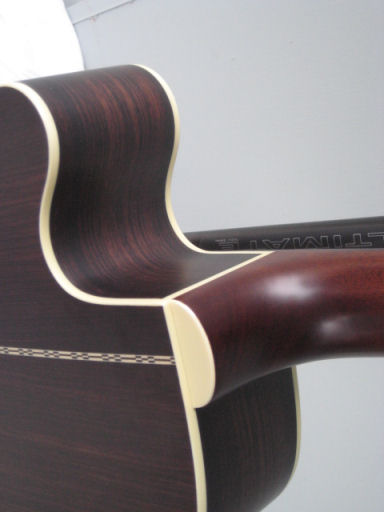
I’ve owned an Epiphone Masterbilt EF-500M for a few years now. It is a very functional instrument that I bought for a very reasonable price. As a result, I’ve been curious about the relatively rare EF-500RCCE model for some time. When a 2nd showed up on Ebay for a reasonable price I snagged it. Here’s a pic:
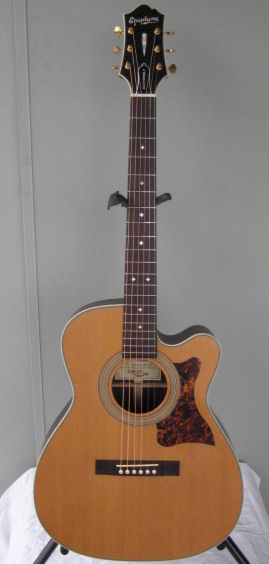
The EF-500 is the 000/OM body size. R indicates rosewood back and sides. The first C stands for cedar top, the second for the cutaway. And the E says it has built-in electronics. The electronics are listed as a Baggs pickup, and since there’s a battery inside there must be some sort of preamp or buffer amp as well. There are no controls mounted in or on the guitar, though, so I’ll have to use an external preamp for tone and volume adjustments. Like all the EF-500 models this one has a 1 3/4 nut width. Unlike the others I’ve tried, it has a modified oval neck shape instead of a V. It also has very slightly narrower bridge spacing, 2 5/16 instead of 2 3/8.

My Epi Masterbilt EF-500M came with a decent semi-hard case. Gibson recently revised the line and now does not include the case in the base price of the instrument, so I’ll be carrying this one in a gig bag.

As I mentioned, this is a 2nd, a QA reject. While many 2nds have invisible issues, the big sap streak in the top makes it clear why this one went on the reject pile:
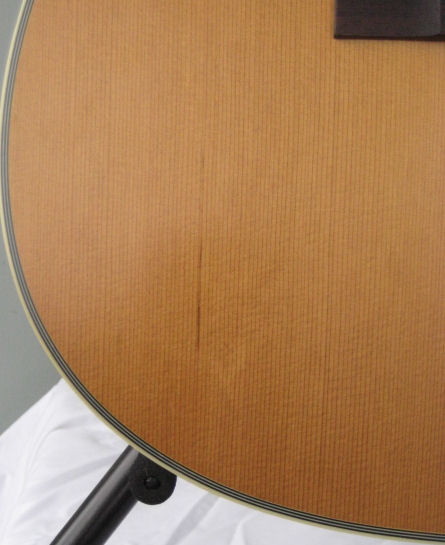
Luckily I’m not a fanatic about the appearance of my guitars, so I’m glad to get a price break because of this flaw. However, there are two other issues, one minor but annoying, the other serious.

The minor issue is the routing of the pickup wiring – it’s downright sloppy, hanging from the top and touching the bottom, so that I sometimes hear a sympathetic vibration buzzing along with the notes. I will fix it with a few bits of tape, but I hope other E models are put together a little more carefully.

Here’s a shot of the battery wire hanging down:

and here’s the pickup lead also hanging:
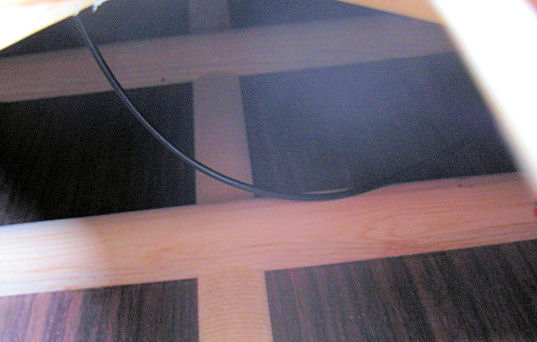
In the second shot you can also see the “broom handle” back braces, much more substantial than I see in higher end instruments.

The significant problem with this guitar is the saddle. It’s leaning forward, which is a definite structural problem.
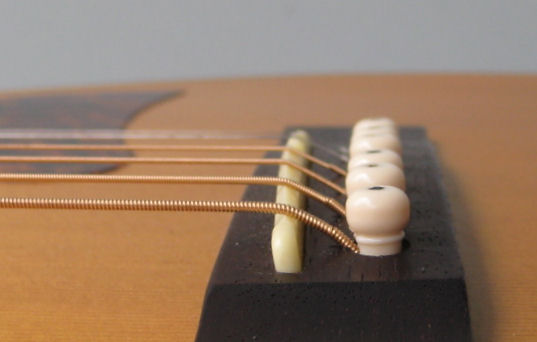
My shot isn’t great for showing the tilt, but it shows the gap behind the saddle clearly. This incorrect construction will likely lead to early failure of the bridge, requiring a somewhat expensive fix. I plan to have the saddle slot rerouted at the correct angle and an oversized saddle fitted to correct the problem, but it is playable in the meantime.

Obviously if I think it’s worth fixing the saddle, I’m pleased enough with the guitar to want to keep it. The playability is just fine, the sound is a bit rough but quite loud, and it’s just generally a fun guitar to play. The cutaway is a big part of the fun, since I do a fair amount of playing around and above the 12the fret. Because of the broad neck heel the cutaway fits smoothly against it, giving a very clean appearance.
Since the real point of a guitar is making music, I put up a Shure KSM141 mic in omni mode, fed it through my John Hardy M-1, and captured a brief clip. I used this setup to give the most accurate picture of the guitars tone, rather than the most flattering recording, and I think the clip is pretty successful in conveying the sound of the guitar in this room.

Sample recording

Note that this is a WAV file rather than an MP3 so the download will take a bit longer. I prefer to use WAV format to maintain the best fidelity.

To summarize my feelings about this guitar, I continue to be amazed by the price/performance ratio of these Epiphone Masterbilts and other recent all solid wood instruments from China. While the construction details, playability, and sound are a step down from a Martin Vintage series (or Standard or 16 series for that matter) this is a functional instrument that’s fun to play, one I would use in just about any situation without feeling shortchanged.

* * * * * * * * * * * *
UPDATE!
* * * * * * * * * * * *

I started doing a little in depth fiddling with the Epi and made a couple of discoveries. Since I had the strings loose I pulled up the saddle to see what kind of Baggs pickup is installed, and the answer is, no Baggs at all! Instead, I found an Artec PP607. Hmmmmmm, is that legal, since the Epiphone site states very clearly that the pickup is a Baggs?? I’m sure they have a disclaimer in there somewhere but this doesn’t give me a lot of confidence in the Masterbilt operation.

The extra thickness of this multi-layer pickup may be responsible for part of my saddle problems as well.

Next I checked the battery holder, to see if I should replace it with my favorite, the B-Band “bag.” Well the answer is YES because the existing holder was barely clinging to the velcro patch. Believe me this a serious problem, because a 9 volt battery banging around loose inside a guitar can do a LOT of damage.

I’m still keeping this guitar for now, but these two discoveries certainly take some of the rosy glow off our relationship.

* * * * * * * * * * * *
UPDATE 2!
* * * * * * * * * * * *

With a little further research I have learned that guitars that pass through the refurb shop, like this one, apparently have the Baggs pickup removed and replaced with the Artec. Something to watch for when you purchase a 2nd with electronics.


Field Recorder Comparison

Saturday, January 12th, 2008

For sheer acoustic guitar and recording fun, it’s hard to beat a visit to Doug Young‘s garage studio. Doug is a fantastic player, very knowledgeable recordist, and has some swell guitars sitting around his great sounding studio space. As an aside, he has done all us acoustic guitar players a huge favor by compiling a great set of pickup samples on his web site. His CD is definitely worth adding to your collection, and his articles in Acoustic Guitar Magazine are always good reading as well.

But for this occasion, I went to take advantage of his extremely cool Sound Devices 744 digital recorder. This is a top of the line system, used widely for major motion pictures or any other situation where great sonics, ruggedness, and portability are needed. I came for a shootout between his “king of the hill” unit and my much more modest recorders, a Fostex FR2-LE and a Zoom H2. Once I arrived, Doug suggested that we add his Edirol R09 to the mix, so we had four field recorders to compare.

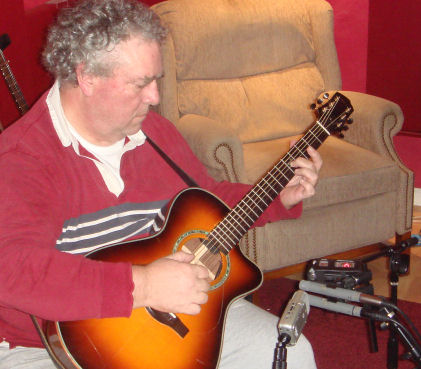
I brought along my Wingert Model E tuned to G Wahine (D G D F# B D), a great old slack key tuning. Doug kindly hooked up his Schoeps CMC 6 mic bodies with his MK41 supercardioid capsules, one into his Sound Devices, and one into the Fostex. Then we rigged the Zoom and Edirol on stands to bring them close to the same position. Here’s what the setup looked like:

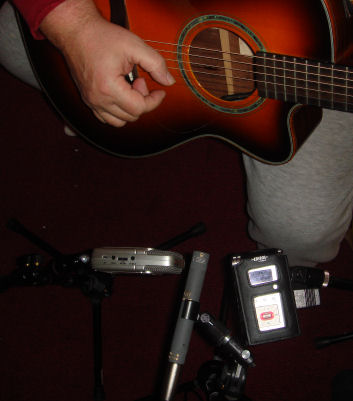
and here’s a shot from over the mics and recorders:

The Schoeps are directly over one another, so the bottom one disappears in this overhead shot.

In some rooms, this setup might not be tight enough to give an accurate comparison, but Doug’s studio is very well treated with broad band absorbers, so the sound is clean and even in most locations. Doug’s room is also extremely quiet, so we got some nice long “tails” as the last note of the clip died away. This will give you a chance to compare the internal noise levels of the different recording chains. One embarrassing caveat – we left the Edirol R09 in MP3 mode instead of 44.1 wave, so that little guy may be suffering some quality degradation. We didn’t realize our error until we’d used up all our time for the evening. Apologies to Edirol and R09 fans.

After the recording session, I brought the clips into my Adobe Audition 3.0 where I trimmed them as accurately as I could to the same starting point and length. (Once again I forgot to “clap” the start of each clip to get a synchronization point – the learning never ends.) I converted the H2 and R09 clips to mono by using the louder of their two tracks. Then I used AA3’s group normalize feature to bring them to the same average loudness. Loudness differences have a tremendous impact on the listener’s sonic evaluation, so I wanted to level the playing field in that aspect. I think average perceived loudness is more useful than peak normalization in this situation, and after processing I listened to the samples on my Dynaudio BM 6 monitors and thought their levels were extremely close.

Now for the samples. Just for fun I’ll post them blind, so you can download them and compare without prejudging. These are .wav files and fairly large, but we wanted to preserve the fidelity so you can make a better comparison.

Sample 1
Sample 2
Sample 3
Sample 4

Now after giving a good listen to these clips, you can see the key here and evaluate the results. I hope you find these comparisons useful, and that you’ll leave a comment or send an email sharing your impressions.

As always thanks a ton to Doug for being so generous with his time, space, and gear.


About the Blog

    Howdy, my name is Fran Guidry and this is my Homebrewed Music blog.

    I play Hawaiian slack key guitar and recorded my solo acoustic CD at home. Most of the recording information I find on the internet seems focused on bands, drums, multitracking, and so on but my main focus is recording solo acoustic guitar. Lately I’ve been enjoying video recording along with audio, so that shows up in the blog as well.

    I’m also a guitar nut. I love big ones and little ones, handmades and factory guitars, cheap ones and expensive ones. So I’ll be sharing the fun of exploring guitars as well, along with the challenges of amplifying acoustic guitars for live performance.

    Welcome!

Philosophy

    My recording philosophy is pragmatic, skeptical, not super critical. After all, the performance is by far the most important component of a track, and every aspect of any recording is a matter of taste.

    But I do like to know “about stuff.” Back in hifi days I learned about double blind testing. I learned that we humans can easily hear differences that don’t really exist. The more I’ve learned about our human auditory system, the more I’m skeptical of what people say they hear, especially if they claim that a particular microphone or preamp or cable has some magical property.

    I’ve only been recording since 2001, and when I started I found the usual places on the internet. I sought advice and accepted it, thought I would improve my recordings by using more expensive equipment. It didn’t work.

    Two things that did seem to lead to better recordings were experience and room treatment. Getting an appealing sound is the combination of many small details, and learning those details only comes from experience. Amd the sound of the recording space is obviously a big factor.

    I’ve only recorded seriously using digital technology, but I remember trying to record rehearsals and gigs back in analog days. I don’t have any nostalgia for analog recording and playback systems at all. I think even low end digital systems can capture marvelous recordings. So when I look at gear, I look for good specs: low noise, broad flat frequency response, wide dynamic range, low distortion. I’m not interested in colorful components, mics and preamps with a sound, I want the sound to be the sound of my guitar.

    But the last word is that I’m just learning and I hope you find something useful in my posts.