Playing the Keys of C and D in Open G Tuning
I think of this blog as being about acoustic guitar playing as much as it is about recording, but somehow the gadgets seem to get most of the attention. I’ve been fooling around with playing in different keys while using open G tuning and came up with a post that focuses on the playing side of things.
Home Sweet Home – Taropatch Tuning
Open G tuning is my home and has been for the last ten years or more. Before I discovered the joy of slack key guitar I thought of tunings as part of bottleneck blues, and I thought tunings meant playing in one key. But a number of Hawaiian musicians showed me that I was mistaken. Kevin Brown of Maui had a huge impact on my understanding of slack key when I saw him play the full range of chords, in whatever key was needed, always in a slack tuning. As I searched and learned I found that the only limit to playing in tunings is the player’s imagination.
Over the years I’ve explored ways to cover different keys, and I got an itch to shoot a little video demonstrating some of these techniques. I wound up with three separate videos, but they should be viewed as a set if possible. Only the first one discusses open G in detail, for instance.
Start in G, Go to C
I’m sort of aiming at folks who are already familiar with open G tuning, but let me start with a chart showing the tuning and the basic I, IV, and V chords.
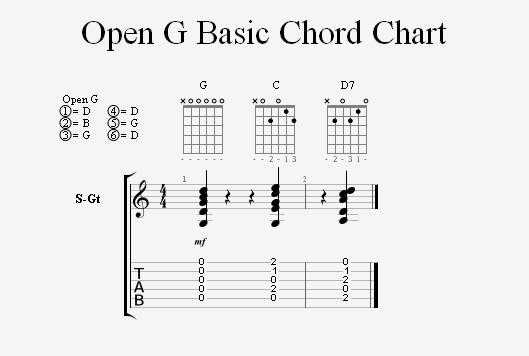
First position chords in open G
Until recently Leonard’s C, the drop C variation of taropatch G tuning was my main tool for going beyond G. This clever variant goes half-way around the scale with a change to one string, dropping the low D down to an even lower C. Not an open tuning, it requires a modified standard tuning C chord shape to play the C major chord.
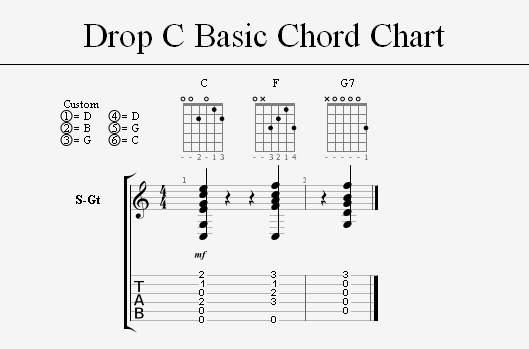
Drop C notes and chords
The open G that remains gives us a lot of great ways to play the V chord, though. The rest of our chord knowledge remains useful as well. The scale is slightly altered, with a new emphasis on the F instead of the F#. But having found E7, Am, etc. in taropatch, those same shapes now make the same chords in the key of C.
Here’s a video that lays the groundwork with G tuning, then demonstrates the details of drop C.
Start in G, Go to D
Plenty of harmonicas and accordians are tuned to a specific key but played in a different key – it’s called cross-tuning or cross-note playing. We can use the same idea to play the key of D while staying in our straight taropatch open G tuning.
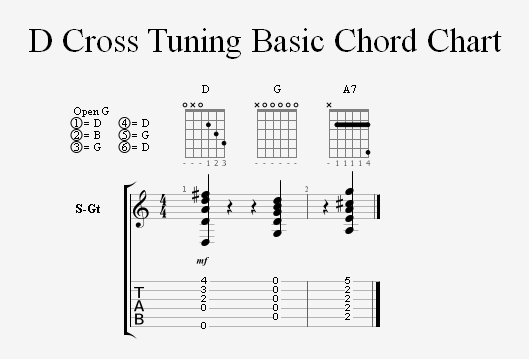
Chords in D, tuning in G
This particular trick gives us a strong IV chord, G in the key of D, but the V chord, A, becomes a bit trickier. The barre at the 2nd fret works, as do the other shapes that one would use in taropatch, but these either require a barre or lack an easy bass note. This lack of an open A bass limits the kinds of runs that can be easily executed in the cross-tuning concept.
One approach to this problem is to choose a song that gives emphasis to the IV chord. Several of Dennis Kamakahi’s classics feature a lot of I to IV chordal movement, and the cross-tuning concept can really work for “Koke`e” or “Wahine `Ilikea.”
Another trick – rearrange the song. In the accompanying video on cross-tuning I sketched out an arrangement of Hula O Makee that changed a few bars of V chord to the IV chord instead.
Start in G, Go to D Again
The capo is usually the first tool I grab when I need to change key. The simple concept of clamping all the strings to a fret is hard to beat in theory, even if the practice can be tweaky at times. But there’s a way to use a capo that’s just a bit trickier.
I’ve seen articles about cut capos and partial capos for years, but I just skipped over them, because they seemed like a gimmicky way to approach the guitar. Lately I’ve had a change of heart because I’ve found the partial capo to give me a nice sounding key of D while using taropatch open G tuning.
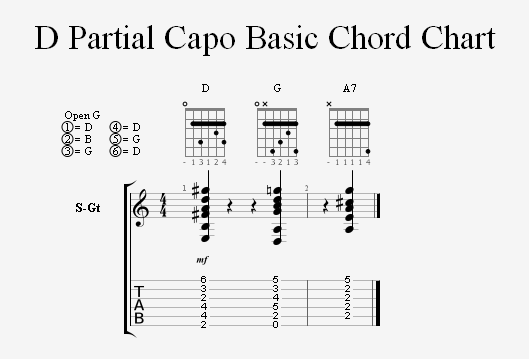
Key of D from open G with a bit of a cheat(er)
The video illustrates this technique, capoing the higher pitched strings 1 through 5 while leaving the 6th string open. This gives the relative equivalent of drop C, one whole step higher, for a version of drop D. This gives us a way to play the key of D with a strong V chord – the five capoed strings spell out an A major chord.
The Singer Calls the Key
Back in my earlier slack key days I played solo instrumentals, occasional instrumental duets, and only very rarely played with vocalists. When I started backing up singers and trying to sing myself, things got a lot more complicated. Suddenly I had to play in any key, because the vocal range is usually very particular, and different for each singer. My sudden interest in the key of D came about when I found several songs I preferred to sing in that key.
There are other reasons to experiment with tunings and cross tunings. Different tunings might lead to different arrangements, different emotional colors. Whatever the reason, whatever the style, I hope this little exploration of the outer boundaries of open G tuning was useful.
This entry was posted on Saturday, June 16th, 2012 at 7:31 pm and is filed under Guitar, Tutorials. You can follow any responses to this entry through the RSS 2.0 feed. You can leave a response, or trackback from your own site.
Pat said in post # 1,
on August 23rd, 2012 at 6:42 pm
Hello Fran,
Thank you for your very helpful posts and videos. Very nice overall quality: sound quality, but also the way you you address the audience and get information across, tempo of speech, manner, structuration of the tutorial. Great work, absolutely.
Thanks also for making me discover slack-key guitar. A lovely musical journey indeed. Nice finger-style playing too.
I have a question. On this last video, with the half-capo, could you tell us what is your recording signal chain (mic/preamp/soundcard/software), and is there any post-treatment (EQ, dynamics). I find the sound quality really outstanding. Very clear and warm sound and floor noise virtually inaudible. So I am very curious to know how you achieve it, if that is OK with you.
Best regards from France,
P.
Fran Guidry said in post # 2,
on August 24th, 2012 at 12:55 pm
Pat, I’m feeling a bit embarrassed. I think of myself as documenting these clips well, but here I am unable to give you the information you’d like. I can give you some general ideas but I can’t be as specific as you might wish, because I didn’t capture the info at the time I created the videos.
I framed the mics out of the shot so I can’t say for certain, but my best guess for the mics would be a pair of Shure KSM141s in cardioid mode, configured in a rough approximation of ORTF – 110 degree angle, 17 cm separation. This has been my most common technique for the last 6 months or so. The mics are between 18″ and 24″ from the guitar, directly in front positioned laterally so I hear a balanced left-right when I monitor in headphones. None of this is super precise, however.
The preamp/converter is an RME UFX. I have a pretty strong opinion that transparent preamps operated in their linear range are nearly impossible to differentiate, and the same is true for converters. Obviously millions of people disagree with me, but so far I haven’t heard a set of level matched same source clips that demonstrate an audible difference, and I’ve heard a number of clips that demonstrate no audible difference.
I captured the audio in REAPER but didn’t do any post processing there. I pulled the audio and all the video clips into Edius Neo, my usual video editor. Edius supports the VST plugin format, so I installed the Toneboosters suite of plugins. Just listening to this clip I would say that I hit the track with the Barricade limiter in order to get my average levels where I like them. I match the volume by ear to the “Flying Orange Hat” clip that I tag on the end. I may have added a touch of reverb, also from Toneboosters. I don’t hear any EQ but a small cut around 180-200 hz is a common tweak for me.
*** Edit ***
I just loaded up the project from my backup and found that I used no effects at all either in REAPER or in Edius. The only adjustment I made was a 3 dB level boost in Edius. So the sound you’re hearing is the guitar, the room, the playing, and the mic position.
***
The low noise levels are easy to achieve, I would say. Most modern mics and preamps are not going to add audible noise, my M-Audio DMP3 for instance would be as quiet as the RME inputs. Since I’m aiming for average levels around -18 dBFS when I record, I’m not pushing any part of my system. I’m lucky to live on a fairly quiet street, and I’ve moved my computer to the next room and feed cables through the wall to reduce computer noise. And I almost always do my recording quite late at night precisely because it’s quieter.
The tonal balance probably comes from two things. This guitar, a Martin OM-18GE, is really a lovely sounding instrument, *** edit *** No use of the limiter or reverb or EQ when I reloaded the project from backup and inspected the REAPER and Edius project. *** and the Barricade limiter lets me push the average level up quite transparently, and a louder sound is “warmer” to our non-linear ears.
The clarity I would ascribe to the room treatment. I’ve installed 23 4″ thick 2×4 foot panels of compressed fiberglass to absorb some of the bass buildup that happens in a small room. These panels also serve to reduce reflectivity in the mids and highs. These are classic low budget broadband absorbers and they made a lot more difference in my recordings than any mic/preamp/soundcard purchase I’ve made. I’ve posted about building the panels and about placing them around the room. I’ve also done a post about using just two of these panels to create a localized zone of reduced reflection. The Owens-Corning compressed fiberglass I use may be hard to find in the EU, I understand that various brands of rockwool work similarly and are more readily available.
I hope this information is helpful. I’ll editorialize a bit to say that when I started recording about 10 years ago the information I found on the internet caused me to think that the gear was extremely important to the result. What I’ve found instead is that experience is more important. Room acoustics and tracking levels are key issues, mic placement can vary the sound quite a bit, mic preamps and converters have little sonic impact but can certainly affect workflow.
Fran
Ed Stone said in post # 3,
on June 22nd, 2013 at 6:21 pm
Aloha Fran,
Thank you for providing the answer to my search: “How the heck do I find the right tuning to play ‘Wahine Ilikea’?”
On your site I’ve found much, much more! I think I’ll get back to noodling with Slack Key again.
Big mahalos to you for sharing such a wealth of information!
Aloha pumehana,
Ed
Fran Guidry said in post # 4,
on June 23rd, 2013 at 10:38 am
Thanks for stopping by, Ed. Have fun with your song, it’s a lovely one.
Fran
Matthew @ Best Guitar Cable said in post # 5,
on February 17th, 2014 at 8:25 pm
Great guide! Once you get the hang of it, open G is so much fun.
Randy Joe Cooper said in post # 6,
on August 5th, 2014 at 3:17 pm
Hope to see more in the future.
Jack said in post # 7,
on April 4th, 2015 at 1:43 pm
Hi Fran,
This is a subject of much interest to me since I am in the process of learning to play in other keys along with ukes in kanikapilas. So far, I am learning the chords in other keys using the chord charts in open G which you no doubt have seen (Dis ‘n Dat). Those chords do have some limitations and since I never played in standard tuning, I am wondering if the chords in standard would work well for my purpose. Or would standard chords have similar limitations? Your views would be appreciated. I noted your remark about Kevin Brown with interest since I hope to corner him at this year’s Maui Workshop about this subject. I met him last year but we only worked on the basic related Open G chords,
Jack
Fran Guidry said in post # 8,
on April 7th, 2015 at 11:52 am
I’m not sure I understand your direction, but I’ll comment anyway (grin). A chord is a collection of notes, not a shape on the guitar neck. So playing the shape of a standard tuning chord while the guitar is tuned to open G will result in a different chord than the one specified in standard tuning. For instance, playing the top four strings in the standard F shape will give an F7 in open G, because the first string is lowered two frets from F to Eflat by the tuning. At each fret this shape would give a major chord in standard tuning and a dominant 7 chord in open G. The difference is even greater if you play a 6 note chord because then you’d have three notes that are altered.
So in order to play chords in open G as expected one must alter the shapes to compensate for the difference in the tuning.
Having said that, some shapes do “work” to make interesting sounds. For instance, the D7 chord in standard tuning makes a D9 chord in open G, and it sounds great!
I use a dynamic app to figure out chords in different tunings, rather than a chord chart. It’s a little more complex but much more flexible and informative. Here’s the one I’m using currently: http://www.looknohands.com/chordhouse/guitar/index_rb.html With this application I can see chords all the way up the neck, find any alteration of chord or tuning as I need them, and only get a mild headache from trying to translate the chart into something my fingers can do (grin).
Hope this helps,
Fran
Jack said in post # 9,
on April 8th, 2015 at 8:02 am
Thanks for the reply Fran. I’m afraid my question was not very clear. I understand that the same chord shapes can’t be used in open G and standard tunings but I was just wondering about the relative merits of playing chords in open G vs. standard tuning when playing with the ukes in keys other than G or C. Specifically, might there be a greater availability of (easy) bass notes in standard tuning in other keys? Thanks for the link to the chord app. Used to have a program on my desktop that was very similar but it got deleted somehow.
Fran Guidry said in post # 10,
on April 10th, 2015 at 12:55 am
If we consider all keys, then for sure standard tuning will deliver the most bass notes for the most keys, but only if you’re handy with barre chords (grin).
The only keys that come with excellent bass notes in open G are G and D, and even those are lacking. No C bass for the IV chord in the key of G, no A bass for the V chord in the key of D.
Standard tuning is well designed for flexibility, at the cost of demanding some techniques that my arthritic hands cannot manage. But with open G, drop C, and a capo, I never run into a key I can’t handle well enough to kanikapila. Well, F (drop C capo 5) is kind of a drag because it takes me into `ukulele range, so I keep a guitar around tuned to F major (G tuned down one whole step) and often use that if I’m expecting to be surrounded by uke players. Then my drop C becomes a Bflat, which makes most uke players whine, cry, and beg for mercy (grin).
Fran
Robert said in post # 11,
on May 3rd, 2015 at 10:46 am
Hello Sir,
Thank you so much for all of the slack key goodies you have on the web!!
When I first found you and Ledward playing together on YouTube it really touched me, tears of joy streaming down my face. Even after repeated viewings of your wonderful playing with Ledward, i still get emotional at times.
Started taking lessons about a year ago, fair progress I guess for not starting until I was in my 40’s. All the time using standard tuning, until I discovered you and Ledward. Now the slack key has taken over, thank you guys for inspiring me so much! I love the way you guys have fun feeding of each other, a real joy to watch/listen.
Advice request: the wife and I are returning to Molokai for a month to hang out with people we met while getting married there in 2013. What would be the best way to bring my Martin omxaeblack with me? We’re flying from mn to Molokai with one night layover on the west coast. What is the most welcomed approach to possibly being able to noodle on the guitar with locals that play?
Thank you very much for your time and sharing,
Robert
Fran Guidry said in post # 12,
on May 3rd, 2015 at 9:37 pm
Robert, thanks for stopping by and for all the kind comments. It’s very rewarding to hear that my efforts are contributing to the spread of slack key and all the good feelings that come with the art form.
I haven’t flown a guitar in quite a while, I’ve managed to stash a couple of guitars in Hawai`i so I can avoid the hassle. But if I were bringing a guitar to the islands I would make every effort to carry it on, with the assumption that a fallback would be to gate check the instrument. With a reasonable case I would expect the guitar to survive a gate check.
As far as connecting with local pickers, I would start scouring the internet for Moloka`i players and maybe also check for hula. I would (and do) also haul the guitar around just about every where and play at every opportunity, hoping to bump into someone.
Moloka`i is a very special place, you’re fortunate to have friends there. It’s an experience of Hawai`i that not many people are able to enjoy.
Fran
Fred Davis said in post # 13,
on August 17th, 2015 at 5:18 pm
Hi. Fran we met years ago (time go so quick) in Newcastal Bar Ca. I have been playing slack key since than easy tran> because I already played Banjo. Wife and I tought Uke to seniors in Citrus Heights Rosevill and Orangevill at there seniors centers and slack key add to the melody of the songs , mostly island and old time camp songs I also learned to play the steel guitar in G and used this to slow down some of the players by increasing my volume to over ride them. Thank you and Led for introducing me to this style of music I have tried to follow all of your CD’s and music on the internet and moved to Santa Cruz hoping to find more hawiian music. Laugh laugh we cannot travel to the islands due to my military disabilitys a couple of hours of standing or sitting and I’m in bed for days so we have made our yard as close to a hawiian beftsro as we can I play most of the day or listen to songs on the internet of Led and others> Recently (last year) I got a Porto Rican 10 string Cuatro about the size of a baratune uke and play it in G even played it for the public on a cruse to Mexico the last spring. I feel that your playing and films have helped to promote Slack Key music more than anyone else in history and I hope and pray you and your lovely wife can continue this for many many years. your in playing the most beautifull music in the WORLD thank you fred
Fran Guidry said in post # 14,
on September 10th, 2015 at 2:12 pm
Thanks, Fred, you’re very kind. I think Geoge Winston and his Dancing Cat records may be a little ahead of me in spreading the love for slack key, but I’m certainly gratified that you think my efforts help.
All the best,
Fran
Joel said in post # 15,
on February 16th, 2016 at 12:45 am
Mahalo nui. I’m a beginner slack key player and love it very much. I can finger puck alright having practiced Flamenco and learned a little watching Ledward Kapa’ana on YouTube, etc. This page gives me some very special chords and pointers that I really need at this moment to improve. Thank you.
Bob Q said in post # 16,
on September 5th, 2016 at 12:40 pm
I’ve viewed almost all of your You tube stuff and now these. I’m curious if you ever sleep, what with all the practicing and gigs you do, and then editing and posting all the videos. I for one, truly appreciate your efforts. Hopefully I’ll catch you and Led again at Honeys in 2017. Might get to Northern Cal in Oct,2016.
Bob Q
Charvis Morse said in post # 17,
on May 28th, 2017 at 5:22 pm
I have 2 Ovations, 6 and 12 string What brand/size strings do you suggest for an unplugged acoustic playing slack key. I have EJ26’s on the 6, and EJ28’s on the 12. For rhythm playing these are alright. But when I slack it to open G, it sounds dull. I mostly play for myself, as it helps this 72 year old remember his hanabada days.
The infor you post is very concise and informative. I keep watching your video’s to expand my repertoire in kihoalu.
Fran Guidry said in post # 18,
on May 28th, 2017 at 7:37 pm
Charvis, I can tell you what I use, but each of us has different needs. I use Elixir 80/20 Nanoweb HD lights. The HD set has heavier gauges for the first three strings, so 13-17-25w-32w-42w-53w and I somethings replace the low E 53 with a 56.
Led uses medium phosphor bronze and doesn’t like 80/20 at all. If the guitar is well setup mediums sound great and they’re not too hard to play since bending strings is not a big part of slack key.
I notice your sets are PB, so you might try a set of 80/20s, like the EJ13 set for the six. Most people find 80/20s to be brighter than Phosphor Bronze.
Fran
Michael Branden said in post # 19,
on December 22nd, 2018 at 4:22 am
Hi Fran!
Today, I discovered this page, your musical world, and I love it. As I’m reading through the different parts, I feel as though you and I are on similar journeys. I will look forward to getting more familiar with the content, and sharing what I can. I’ve had a few small studios in my life, and tried a lot of gear and techniques. Always cool to hear what someone else is doing. Where do you live? I’m originally from So. Cal., but now I’m bouncing between two houses, CT and Maine.
Merry Christmas, and thank you!
Michael Branden
Mike Wichmann said in post # 20,
on March 22nd, 2019 at 3:13 am
Fran, this is a heartfelt note of thanks for these gifts you have shared with the world. A while back I stumbled upon your YouTube video with Led Kaapana playing the Kolomona Slack Key (written by Ned Kaapana). That’s one of the most peaceful, hopeful and healing tunes I’ve ever heard, and you two set it free. That video “Led” me to your REALLY great website. I’ve been playing guitar for more than 40 years now and I’m soon to retire. I’ve got a few things on my bucket list, but near the top is finally learning to play slack key. I’m learning from you already and hope to meet you someday. They say that music is the language that can heal the world. So, let me speak on behalf of the world and say mahalo to you Fran.
Mike Wichmann
Mariposa, CA and Centennial, CO